How Smoking Accelerates the Deterioration of Existing Rhinitis, Sinusitis, and Allergic Rhinitis
If you already suffer from chronic nasal congestion, runny nose, sneezing, head tightness, or repeatedly find that "your nose never fully recovers after a cold," an otolaryngologist will likely tell you that the problem lies in the nasal mucosa and sinus drainage. If you are still smoking — or are chronically exposed to secondhand smoke — the smoke is not "a separate issue"; it directly impacts the same tissue that is already inflamed and fragile.
This article explains how smoking **accelerates** existing nasal conditions through **mucosal barrier disruption, inflammatory amplification, and ciliary dysfunction**, and provides realistic expectations for improvement after quitting. The goal is not to frighten, but to help you understand why the same medication and the same nasal rinses often fail to stabilize when smoking continues.
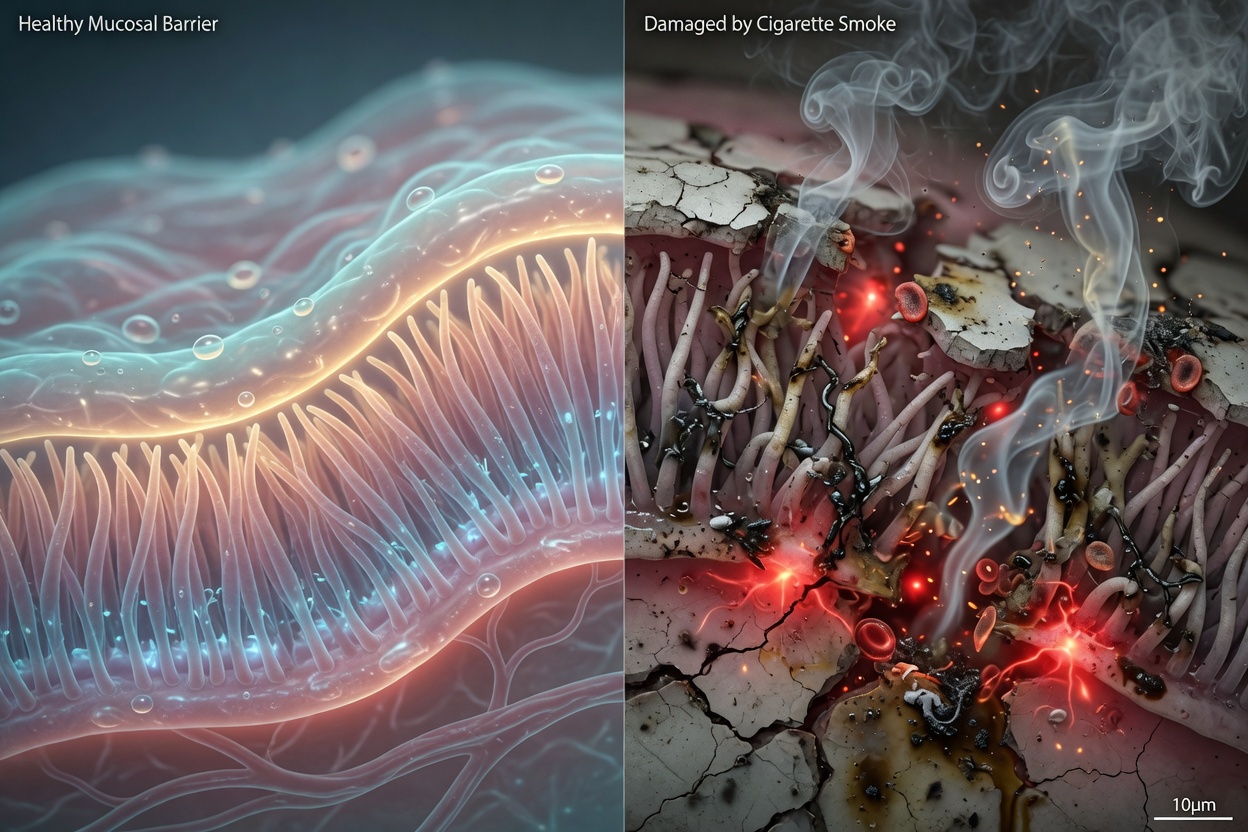
I. First, understand the baseline: When you already have a nasal condition, your nose is not "at full capacity"
A healthy nose relies on three things to maintain balance:
1. **An intact epithelial barrier** — cells tightly connected like a city wall, keeping allergens, bacteria, and irritants out or limiting their penetration;
2. **The mucociliary clearance system** — mucus traps debris, and cilia beat in coordinated rhythm to transport waste away;
3. **Controlled local inflammation and immunity** — reacting when necessary and calming down when appropriate, without excessive swelling or secretion.
Rhinitis, sinusitis, and allergic rhinitis are essentially conditions where at least one of these three systems is already imbalanced: mucosal edema, abnormal secretion, increased barrier permeability, obstructed sinus drainage, or an overly low "allergic threshold" to stimuli such as pollen or dust mites. Inhaling cigarette smoke at this point adds **chronic chemical irritation, oxidative stress, and particulate burden on top of existing lesions**.
Here is a very practical takeaway:
**Smoking harms a healthy nose; for a nose that already has a condition, it often acts as an "accelerator."**
II. Mucosal Barrier: The wall cracks first, then smoke pours into the cracks
1. The first layer smoke encounters is the nasal epithelium
When smoking, high-temperature airflow carrying a complex mixture (particulates, tar-related compounds, aldehydes, oxidants, polycyclic aromatic hydrocarbons, etc.) first passes through the nasal vestibule, turbinates, and nasal passages. For mucosa that is already inflamed, the epithelium is often congested, fragile, and partially damaged — **the same concentration of irritant causes greater discomfort and injury**.
2. How the barrier is further dismantled
Published research and pathological observations indicate that chronic smoke exposure is associated with:
- Weakened epithelial cell junctions and barrier function, increased permeability;
- Increased oxidative stress, imbalance between cell damage and repair;
- Abnormal mucus blanket composition and thickness, reduced defensive "coat" quality;
- Local microenvironment becoming more favorable for pathogen colonization or allergen penetration to immune cells.
The result is not an abstract "damaged mucosa," but very concrete daily experiences:
- Even a slight draft, dust, or cooking smoke worsens nasal congestion;
- Seasons you previously tolerated now bring worse sneezing and clear discharge;
- Medication brings temporary relief, but exposure to smoke quickly "resets" you.
**The worse the barrier, the easier outside triggers set it off.** This is the first meaning of "accelerated deterioration": a lowered threshold.
3. Secondhand smoke is not safe either
People who do not actively smoke but live in smoky environments also have their nasal mucosa exposed to particulates and irritant gases. For those with existing allergic rhinitis or chronic sinusitis, smoke control at home and in the workplace is often an underestimated component of treatment.
III. Inflammatory Amplification: Both allergic and infectious pathways can be ignited
1. Smoke rarely "creates a new allergen," but it is very good at "fanning the flames"
The classic pathway of allergic rhinitis involves IgE mediation, mast cell degranulation, histamine and other mediator release, manifesting as sneezing, clear runny nose, nasal itching, and congestion. Tobacco smoke is not typically a "pollen-type allergen," but as a **potent non-specific irritant**, it can:
- Stimulate epithelial and immune cells to release pro-inflammatory mediators;
- Worsen mucosal congestion, edema, and hyperreactivity;
- Make an already allergic nose more sensitive to true allergens, with more severe symptoms and slower recovery.
A common clinical picture: allergen management is only average, and with smoking layered on top, **antiallergic medications and nasal steroid sprays "can't keep up" or symptoms rebound upon discontinuation**.
2. Sinusitis: Inflammation + drainage obstruction = easier recurrence
Sinuses need narrow ostia for ventilation and drainage. When mucosa swells, polyps form, or mucus stagnates, bacteria multiply more easily, triggering acute episodes or chronic persistence. The chronic inflammation and ciliary impairment brought by smoke (detailed in the next section) make the ostial area more prone to blockage, leading to:
- Nasal congestion and discharge dragging on long after a cold;
- Cheek/forehead pain, postnasal drip, pharyngeal foreign body sensation;
- Recurrence after antibiotics or brief improvement.
Here "acceleration" often means: **more frequent episodes, longer disease courses, and poorer response to comprehensive treatment** — rather than a dramatic number appearing on one test.
3. Inflammation compounds itself, dragging down sleep and daytime function
Nighttime congestion impairs sleep, and poor sleep lowers overall tolerance, forming a vicious cycle of "nasal disease — poor sleep — daytime fatigue — greater reliance on smoking to stay alert." For those with existing nasal conditions, the motivation to quit is sometimes not abstract "health," but **wanting to be able to sleep at night and blow your nose less during the day**.
IV. Ciliary Paralysis: The cleaning system slows down, and the condition easily "stagnates"
1. Mucociliary clearance: The nose's "automatic sweeper"
Under normal conditions, cilia beat in coordinated rhythm, transporting the mucus blanket along with dust, microorganisms, and allergen debris backward, where it is ultimately swallowed or coughed out. This is one of the most important self-cleaning mechanisms of the upper respiratory tract.
2. How smoke disables the sweeper
Chronic smoke exposure is associated with damage to ciliary structure and function, including:
- Cilia collapse, shortening, and reduced number;
- Decreased beating frequency and coordination;
- Goblet cell and mucus secretion disorders — some people hypersecrete (more nasal discharge), others later develop dryness and crusting;
- When mucus becomes too thick, even if cilia are still moving, they "can't push it."
For people with existing rhinitis or sinusitis, this means:
| Function | Healthy State | Common Result with Smoking |
| Capturing debris | Moderate mucus | Excessive or overly thick mucus |
| Transport outward | Efficient cilia | Slowed transport, stagnation |
| Sinus drainage | Relatively open | More prone to fluid accumulation, secondary infection |
| Medication efficacy | Easy to maintain after anti-inflammatory treatment | Irritant source persists, drug effect hard to consolidate |
3. The common root of postnasal drip and throat discomfort
When clearance slows, secretions flow backward more easily, causing throat clearing, dryness, foreign body sensation, and even being mistaken for "chronic pharyngitis as a separate condition." For smokers, the nose—pharynx—lower airway is a continuous tract; impaired nasal clearance passes the problem downstream.
V. Three Common Nasal Conditions: How Smoking "Steps on the Gas" for Each
1. Chronic / vasomotor (non-allergic) rhinitis tendency
- Smoke directly stimulates blood vessels and nerve reflexes, making congestion and discharge more volatile;
- Mucosal dryness and hypersecretion can alternate, leaving you feeling "nothing works";
- Under chronic stimulation, symptoms become more fixed, with increased reliance on simple cold medications.
2. Sinusitis (including recurrent acute episodes and chronic course)
- Impaired cilia and drainage → secretion stagnation;
- Barrier and inflammation issues → elevated infection threshold;
- Treatment requires a comprehensive approach (medication, rinses, potentially surgical evaluation), **and if smoke exposure is not reduced, recurrence risk is often higher**.
3. Allergic rhinitis
- Hyperreactivity is further amplified;
- Seasonal or perennial symptoms become more severe, more pronounced at night;
- When combined with asthma or lower airway hyperreactivity, smoke can become a driver of simultaneous deterioration in both upper and lower airways (this article focuses on the nose, but the risk can extend downward).
The three can overlap: allergic rhinitis complicated by sinusitis is very common. Smoking's "acceleration" is often more pronounced in such overlapping patients.
VI. After Quitting: What Changes Can Be Expected (with approximate timeline)
Boundaries must be stated first:
- **Quitting removes the accelerator and ongoing irritant source**, it does not mean all nasal conditions automatically disappear;
- Existing severe structural issues (significant deviation, polyps, irreversible remodeling, etc.) may still require specialist intervention;
- Individual variation is large: smoking history, daily cigarette count, allergen control, medication adherence, and occupational dust exposure all affect the recovery curve.
With that in mind, the **possible improvements** observed in clinical experience and research directions are as follows (understand these as approximate ranges, not guaranteed timetables):
Days to 2–4 weeks
- After the direct irritant effect of smoke is removed, some people experience reduced nasal burning sensation, irritant-induced discharge, or the immediate "blocked when I smoke" reaction;
- Oral and nasal odor, morning irritation may improve;
- If nasal steroid sprays, antihistamines, or a doctor's regimen are maintained, subjective congestion fluctuations may become "less dramatic."
Approximately 1–3 months
- Mucociliary function has an opportunity to gradually recover after removal of the irritant (speed varies by individual);
- Mucus characteristics may shift from "sticky and copious / dry and crusty" toward something closer to normal;
- Some people experience longer intervals between acute episodes, and better tolerance and efficacy of nasal rinses.
3–12 months and beyond
- With reduced inflammatory burden, allergy controllability may improve (allergen management still needed);
- The frequency of recurrent sinus infections may decrease in some individuals;
- Impaired sense of smell, if related to mucosal edema and chronic inflammation, may have some room for improvement; if damage is more severe, recovery may be incomplete.
**One sentence for reasonable expectations:**
After quitting, most people first notice "less irritation, less fluctuation, medication works better"; a complete "nose like it was never sick" is unrealistic, but **moving the condition from "accelerated deterioration" to "a manageable chronic state" is itself a huge gain**.
VII. Treating Nasal Conditions While Removing Smoke: Actionable Advice
1. Don't stop at "toughing out" nasal treatment
- Allergic rhinitis: Use nasal corticosteroids and antihistamines per guidelines or prescription, rather than long-term abuse of decongestant drops;
- Sinusitis: Follow medical advice on whether anti-inflammatory, anti-infective treatment, rinses, or further investigation is needed;
- Long-term self-use of vasoconstrictor nasal drops can cause drug-induced rhinitis, making things worse.
2. Smoke exposure is part of the treatment plan
- Active smoking: Develop a reduction and cessation plan, seek formal smoking cessation support if needed;
- Secondhand smoke: Establish a smoke-free home environment and set boundaries at work and social settings;
- E-cigarettes / heated tobacco: The irritant profile differs, but for already sensitive nasal mucosa, **"switching how you inhale" is not the same as being friendly to your nasal condition** — not a safe alternative when you already have rhinitis.
3. Supportive care (under a doctor's guidance)
- Saline or doctor-recommended nasal rinses: Help mechanically clear secretions and irritants;
- Maintain appropriate indoor humidity, avoid excessive dryness;
- Reduce additional irritants such as dust, cooking smoke, and strong fragrances;
- For those with identified allergens, environmental control (bedding, mites, pets, pollen seasons) is as important as quitting smoking.
4. Seek medical attention promptly for these situations
- Unilateral progressively worsening congestion or blood-tinged discharge;
- Severe headache, vision changes, proptosis or limited eye movement;
- High fever, evident redness and severe pain over the cheeks;
- Sudden evident smell loss that does not recover;
- Nasal conditions and smoke exposure in children or pregnant women should be professionally evaluated as early as possible.
This article cannot replace in-person consultation and individualized treatment.
VIII. Conclusion
When you already have rhinitis, sinusitis, or allergic rhinitis, your nose is "operating while injured." Smoking, by **breaking down the barrier, fanning inflammation, and slowing ciliary clearance**, pushes the existing pathological process toward more frequent, more prolonged, and harder-to-treat episodes. Quitting will not instantly rebuild a perfect nose, but it removes the foot that keeps pressing down — allowing standard treatment, nasal care, and allergen management to truly have a chance to stabilize.
If you are already treating your nose but feel that "no matter what I do, it's never quite right," honestly include smoke exposure in your condition checklist: it is often not the only cause, but it may well be the overlooked accelerator.
Key Takeaways
1. **Existing nasal condition = mucosa and clearance system already compromised**; smoking adds chronic irritation on top of the lesion, not a separate issue.
2. **Barrier disruption** makes allergens and pathogens more likely to trigger symptoms; threshold lowered.
3. **Inflammatory amplification** can worsen allergic hyperreactivity and make sinus drainage areas more prone to recurrent infection.
4. **Ciliary and mucus dysfunction** leads to secretion stagnation, postnasal drip, and difficulty consolidating drug efficacy.
5. All three types of nasal conditions can be "accelerated"; **more pronounced when overlapping**; secondhand smoke equally relevant.
6. Weeks to months after quitting, irritant response, ciliary function, and episode frequency **may** improve, but individual variation is large.
7. Quitting removes the accelerator, **it cannot replace** standard rhinitis/sinusitis treatment and allergen management.
8. If red-flag symptoms appear or conditions are chronically persistent, seek timely otolaryngology evaluation rather than toughing it out or self-medicating with nasal drops.
If you already have rhinitis or sinusitis, smoking adds chronic irritation on top of existing lesions. This article explains the mechanisms through mucosal barrier disruption, inflammatory amplification, and ciliary dysfunction.
Before vs After Smoking: Nasal Function Comparison
黏液适度,屏障完整
纤毛高效摆动,运输顺畅
窦腔引流通畅
抗炎治疗后易维持效果
This article focuses on the nose, but risks can extend downward to the lower airways
Motivation to quit is sometimes not abstract health, but wanting to sleep at night and blow your nose less during the day